Read time: about 4 minutes
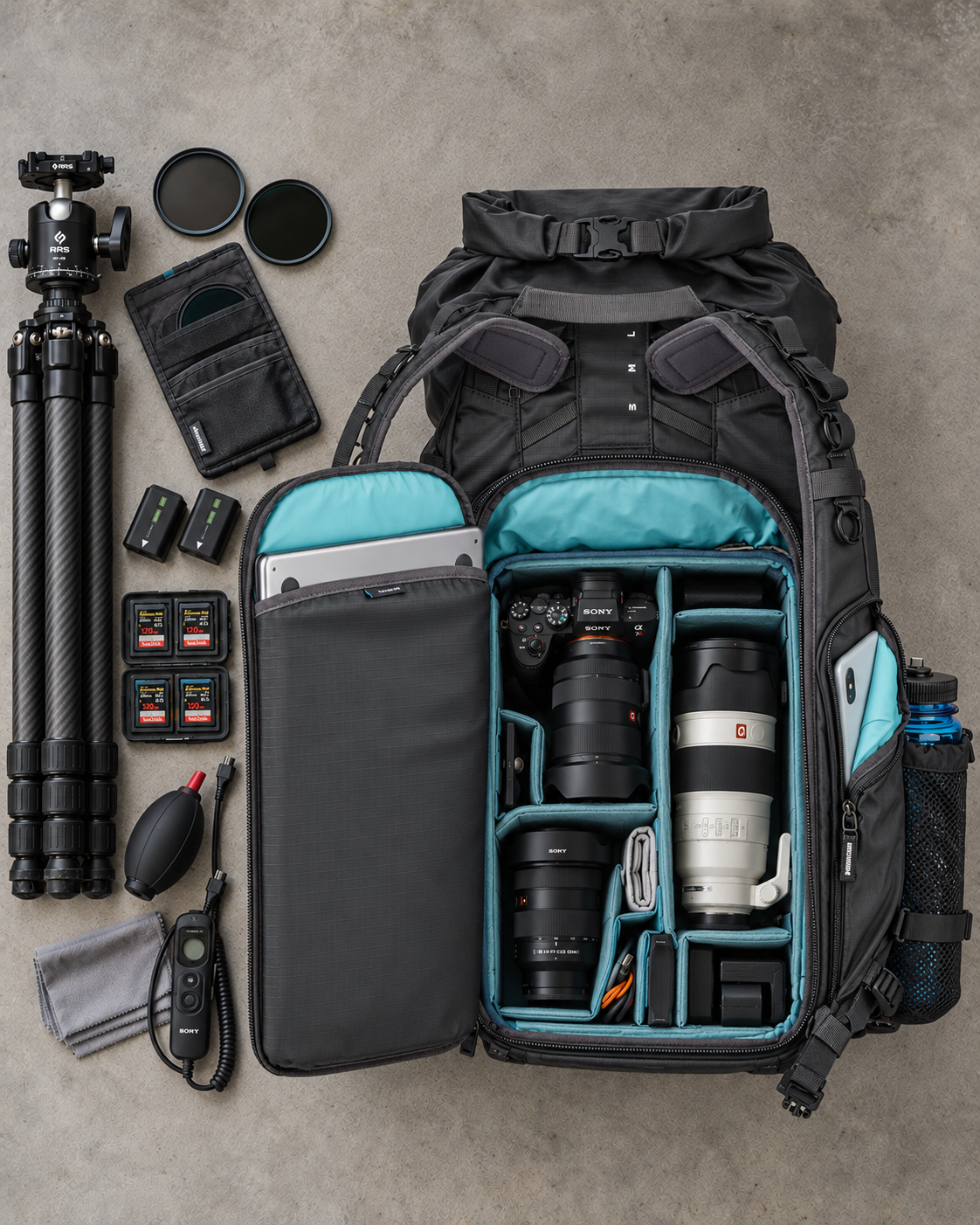
Packing for a flight with photography gear is an exercise in honesty. Every piece of gear has to earn its place, because everything you bring, you carry: through the airport, down the beach and back again at 5 a.m. For the Keys, this is what made the cut.
The camera: Sony a7R V
The a7R V is the center of everything I shoot. Its full-frame sensor gives me the detail and room to print large, which matters when an image might end up 72 inches wide on someone’s wall as an acrylic piece. At that size, every frond on a palm and every ripple in the sand has to hold up to someone standing a foot away. The resolution also gives me room to crop and refine a composition later without giving up the quality a Masterworks print demands.
Just as important is the dynamic range. The hardest part of a sunrise is the contrast: a bright, glowing sky over a beach that’s still in shadow. The a7R V holds detail at both ends, so I can bring back the warmth in the clouds and the texture in the sand from a single, carefully exposed frame, without the image looking processed.
The fully articulating screen tilts and flips, so I can compose from a low angle with the tripod nearly on the sand without lying down in it. The in-body stabilization helps when I’m walking the shoreline handheld, scouting compositions as the light comes up. And it’s built to resist dust and moisture, which matters on a beach where salt spray, humidity and blowing sand are part of every morning.
The lenses: three zooms that cover it all
Three zooms, wide to telephoto, means I'm never stuck without the focal length a scene needs.
Sony FE 12–24mm for the wide, immersive scenes: palms overhead, foreground sand, the whole sky.
Sony FE 28–70mm f/2 GM for the middle ground, the most natural view of a scene, with a fast aperture when the light runs out.
Sony FE 70–200mm f/4 for pulling details out of a big scene: a single palm against the sky, the sun on the horizon, layers of light on the water. The f/4 version is noticeably lighter, which counts when everything has to join me on my flight.
The polarizer: PolarPro QuartzLine CPL
In the tropics, a circular polarizer is the one filter I wouldn't leave behind. It cuts the glare off the water so you can see the color and the sand beneath the surface, deepens a blue sky, and pulls the shine off wet leaves and rocks. Turn it, and the turquoise in the shallows comes back.
The support: Colorado Tripod Company and Really Right Stuff BH-40
Sunrise means long exposures in low light, so a solid tripod isn't optional. Mine is the Centennial from Colorado Tripod Company, topped with a Really Right Stuff BH-40 ballhead: compact and light enough to fly with, but rock solid once it's locked down. On a beach that matters, with sand shifting underfoot and a breeze off the water.
Carrying it: Shimoda Action X and Peak Design Slide Lite
Everything travels in a Shimoda Action X40, a pack built for photographers who move. It goes on the plane with me, because my camera gear never goes in checked luggage. It fits in the overhead bin, carries comfortably on a pre-dawn walk, and opens from the back, so I can get to the camera without setting the bag down in the sand.
The camera rides on a Peak Design Slide Lite strap. It's quick to attach and remove, so it comes off when the camera goes on the tripod and back on when I'm walking the shoreline looking for the next composition.
What stayed home
Flying changes the math. To save space and weight, I left some of my heavier kit behind:
My panorama kit. Pano rails and a nodal setup are wonderful for big, stitched landscapes, but they add bulk. On this trip, the 12–24mm covered the wide scenes.
My drone. Aerials of the Keys are spectacular, but a drone adds batteries, a charger and its own case to the load.
Every trip involves trade-offs like these. The best kit isn't the biggest one; it's the one that's with you, set up and ready when the light arrives. On the fourth morning in Islamorada, everything I needed was already on the tripod.
The craft lesson: pack for the light, not the trip
Before every trip, I ask one question: what will the light and the landscape actually ask of me? For the Keys, the answer was wide scenes, water and sunrise. That meant a wide lens, a polarizer and a steady tripod mattered more than anything else. Start there, and the rest of the packing list writes itself.
Read the story behind Driftwood Dreams →