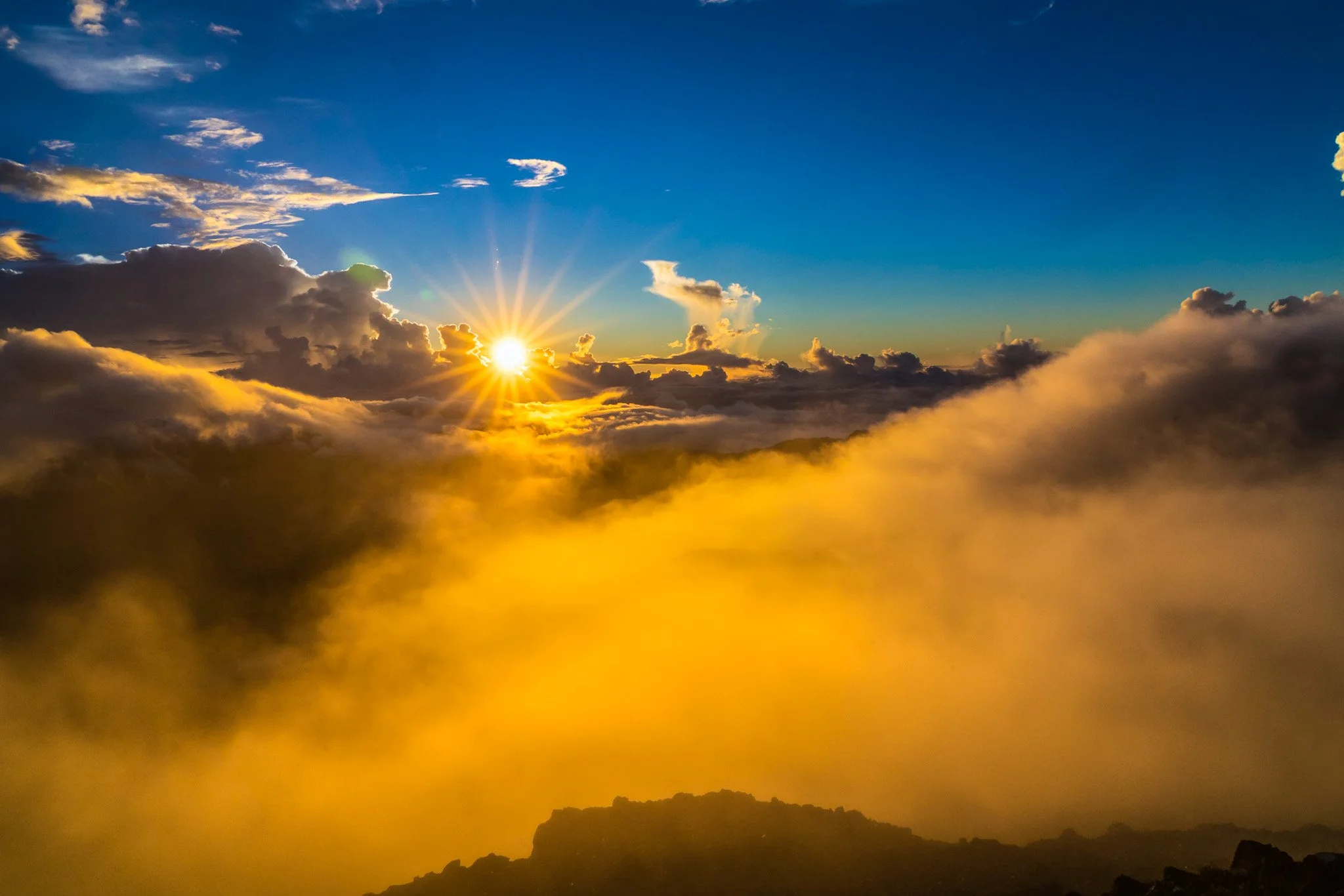
In Islamorada, I stood on the same shoreline for four mornings before I got the photograph. The first three were flawless days, and that was the problem. Great light rarely just happens. Most of the work is reading the conditions well enough to know when, and where, it's likely to show up.
Here's what I look at before I set an alarm.
1. Clouds: the canvas for the light
The sun provides the color. Clouds give it somewhere to land.
Mid and high clouds (scattered, textured, often looking like ripples or streaks) are what you're hoping for. They catch the color before and after the sun breaks the horizon.
A thick band of low cloud on the horizon is the spoiler. It blocks the sun just when the show should start.
The ideal: a clear gap at the horizon where the sun will rise or set, with broken clouds overhead to catch the light.
What you don’t want, as a photographer, is a completely clear sky, this produces clean, bright light but little drama. Beautiful to stand in, flat to photograph.
2. Aspect: which way the land is facing
In the mountains, a slope's aspect is the direction it faces. It decides when the light reaches it and when it leaves. An east-facing wall glows at sunrise; a west-facing one lights up at sunset. That's part of why this journal is called Aspect: so much of landscape photography is understanding which way things face, the land and the camera alike.
Before a shoot, I work out:
Where the sun will rise or set on that date. Its position on the horizon shifts noticeably through the year.
Which surfaces it will hit first, and which will stay in shadow.
Where I need to stand for the light to fall across the scene. A rule you hear a lot about in photography, avoid shooting straight into the light. This is perhaps my favorite “rule” to break. I just love the starburst effect of the sun rising/setting in my shots. Try it and see what you think.
3. Timing: earlier than you think
The best color often comes before sunrise and after sunset, when clouds are lit from below while the land is still in shadow. Blue hour, the cool, quiet light on either side of sunrise and sunset, is underrated in its own right.
My rule: be set up, composed and waiting at least 45 minutes before sunrise. I prefer a full hour. That sounds like a lot until you’ve watched the best color of the morning happen 20 minutes before the sun appears. The light changes fast, and finding a composition in the dark while it’s happening is how shots get missed. An hour gives me time to walk the scene, settle on a composition, check focus and exposure, and then simply wait, ready for whatever the sky does. This is a great time to enjoy a nice hot cup of coffee or tea while you wait for the light show to begin.
4. The tools I use
Two apps do most of the heavy lifting for me, so I can focus on the scene.
PhotoPills for the sun. It shows exactly where the sun will rise or set on the horizon for any date and location, and when. I use it to plan where to stand before I ever arrive, and to know which faces of the landscape the first light will hit.
Windy for the clouds. Instead of a single "cloudy" percentage, Windy breaks cloud cover down into low, mid and high levels. That's exactly what matters for sunrise: high and mid clouds to catch the color, and a clear horizon so the light can reach them.
Neither one can promise a great sunrise. Together, they tell me when it's worth setting the alarm.
5. Go back
No forecast replaces returning to a place. Each visit teaches you something: where the light falls, what the foreground looks like at low tide, what the vegetation looks like in spring vs. late summer, where the clean composition is.
Find a composition you love, one where you can already picture the finished image, and then commit to it. Go back, and go back again, until the conditions match what you see in your head. Each visit teaches you something new: where the light lands first, how the foreground changes, which clouds work and which ones don't, exactly where to put the tripod. By the time everything finally lines up, there's nothing left to figure out. You just have to be there.
In Islamorada, that took four mornings. Some of my favorite images have taken years.
Patience and persistence
If I had to name the most important skills in landscape photography, they wouldn't be technical. Cameras, lenses and editing can all be learned. Patience and persistence are what actually make the picture.
Most of what I do is waiting: for the clouds to arrive, for the wind to drop, for the light to break through for 30 seconds before it's gone. Many mornings end with nothing. Those mornings aren't failures. They're part of the process, and they're the reason the good ones feel the way they do.
Getting comfortable being uncomfortable
The best light rarely shows up when it's convenient. It comes on frigid winter mornings when your fingers won't work the dials, in desert heat that starts before sunrise, in wind that won't let a tripod settle, and in rain that clears just as you're about to give up. More than once, the most dramatic conditions have come in the worst weather.
You learn to dress for it, to carry what keeps you and your gear going, and mostly just to stay. The photographers who come home with the extraordinary image are usually the ones who were willing to be cold, tired and wet a little longer than everyone else.
So pick your scene. Watch the forecast. Set the alarm an hour earlier than feels reasonable. Then go back, as many times as it takes.
Read the story behind Driftwood Dreams →